calling

4 Tips for Making the Winning Audition Choice

Most ‘experts’ who talk about actors “making choices” haven’t a clue what a “choice” actually is, nor how to properly compose and execute one. This is true both in the audition room and on set. Casting directors and film/TV directors will often tell actors to “make a stronger choice” not really knowing what exactly they mean by that. Essentially they’re saying, “show me something I like better.” I often see this in instructions for actors for submitting a taped audition. It’s one of those hot button terms—“making a choice”—but ask that ‘expert’ to demonstrate what the hell they’re talking about, and watch most them start to squirm and filibuster their way through an answer.

Rule #1 Is Always the Same

Don’t guess what THEY are looking for! Assume YOU are who they’re looking for, and bring yourself to the role with a brave, fun, and impactful choice. Which means, it is your right and responsibility to always do “your version” of the character—how you see it. It means relentlessly looking for ways to find what being this character means to you. This does not mean that you’re playing yourself! It means that your winning performance—once all work has been absorbed into your bloodstream—should feel as easy and loose as if you were playing yourself.

Winning Choices Are Not Found Within the Text

Proper textual analysis must be done with the same specificity and expertise that a member of the LA Philharmonic would prepare Mahler’s Third. The text must ultimately serve as a springboard for your deeply imaginative and improvisational process of connecting what it all means to you.

Margot Robbie on how she won the role in “The Wolf of Wall Street”:

"So I walk up really close to his face and then I'm like, 'Maybe I should kiss him. When else am I ever going to get a chance to kiss Leo DiCaprio, ever?' But another part of my brain clicks and I just go, 'Whack!' I hit him in the face. And then I scream, 'F--- you!' And that's not in the script at all. The room just went dead silent and I froze." (cinemablend)

Doing this kind of stuff is scary. It’s risky. Margot Robbie instantly thought they were going to call the cops on her or sue her for hitting one of the most bankable stars on the planet. She was wrong: they offered her the part, and the rest is history. And hell, isn’t this why you became an actor? To scare people, scare yourself and to take risks? Did you really leave your hometown and everything you knew to go into rooms, play it safe, and show the casting and producing team a slightly different version of the same boring character they’ve seen all day? How has that been working for you?

Stop Obeying Character Descriptions

Most actors make the rookie mistake—especially in auditions—of thinking they must obey and act all character descriptions and stage directions. Be assured that this will be what every other actor does as it represents the obvious choice—its goal is to please the casting director. Show the producing team that you understand the character and the entire project well enough to invent a gesture or movement that is not in the script but which demonstrates that you get it—and you’re confident enough to create something more nuanced right before their very eyes.

Remember the casting directors are not the ones who call the final shots. Some of my readership are often surprised upon learning that the final casting decisions are made by the directors, producers or writers, and not the casting directors.    

Winning Choices Must Be Visually Obvious Choices

If a director, writer, producer, or casting director cannot check a box that says “Visually obvious choice made,” then you haven’t made a choice that works—or at least not one that will win the role or get you that nomination. Actors forget that their choices need to read on camera, even if the sound is off. Their performance should be able to be watched with the mute button on, and still read as driven and emotionally loaded. Unlike on set work, auditions are when you must achieve this immediately to be successful—oftentimes within the first 10 seconds.

Using a strong hook to launch you into your scene can trigger that visually obvious choice—the kind of choice Margot Robbie made.  

With the highest actor booking rate in the industry, we help actors make the confident and brave choices to stand out and win the role.

This article was originally posted on Backstage
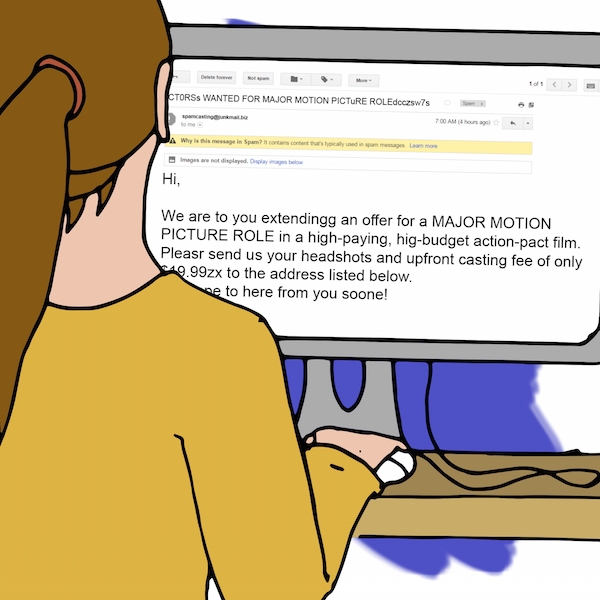


A Sign of an Acting Scam

One of the biggest acting scams in the industry are those unsavory bandits who try to sell actors on the losing proposition of finding their “niche” or “type.” It’s like attempting to steal your personality and sell you back a second-rate version of yourself. The pursuit of niche/type is the occupation of the Sunday driver actor, as it revolves around trying to find what pre-prescribed stale box(es) you could neatly package yourself into—all for the purpose of pleasing! It’s herd mentality crap, and it’s sold to the stampede of actors who believe there’s one pre-prescribed path to industry success.

The higher art form is to do what's taught at Harvard Business School and distill your "singularity," or "value proposition"—it's your wow factor and the DNA of your branding! It's the unique combination of attitudes and behaviors that make you an original and set you apart from the herd. It's showing the industry what they never saw before and desperately must have because no one else can do it. I help actors discover their unique singularity, and help them use it to launch their careers, on their own terms.

This article was originally posted on Backstage

Why You Must Always Be at Your Olympic Best

The brutally competitive L.A. and NYC film and TV markets represent the Olympic level of the game for actors. It’s a very small industry, in that actors who audition for major film and TV roles end up meeting most of the top casting directors in any given year. If you’re not at your Olympic best—in shape and on your A game like an elite athlete—then you run the very real risk of closing more doors than you open in this industry. This is the equivalent of waking up one morning and deciding you love the tuba more than life itself, and after taking lessons for six months, decide it’s time to get on stage at Walt Disney Concert Hall to audition for the conductor of the L.A. Philharmonic.

In my work with actors, I help them reach their Olympic best every session, so they’re ready to go into the audition room, mark their territory, and either book the role or the room!

The Biggest Fear Every Working Actor Must Overcome

To be a successful actor you must overcome the fear of boundless rejection: not being good enough, beautiful enough, talented enough, etc. At the actor’s emotional core is the profound human need to be seen and loved. Part of paying your dues in this business—both Oscar winner and beginner—is the reality of constant rejection throughout your career. The look on Leonardo DiCaprio’s face at the 86th Academy Awards after his fifth Oscar nomination for “The Wolf of Wall Street” resulted in a loss shows you that no one is immune to rejection. Not everyone is built to endure this, nor do they have the stamina to last for the long game. I believe this fear of rejection—both in the audition and on set—can be defeated when you’re on the support of a brave and impactful choice. Not being afraid to look like an asshole or a freak and adopting the attitude, “Anyone who doesn’t like me can kiss my ass!” can also fortify you with enough confidence to burn through the fog of fear.

This article was originally posted on Backstage

A New Year’s Resolution for the Successful Actor

Actors need to get that anything capable of being accomplished can be done, including launching a successful acting career. Stop undermining yourselves by dreaming up obstacles to your success: memorizing lines, not having a reel, no representation, no major credits, etc... are all bullshit excuses for delaying your career a day longer. Our actors get that nine-tenths of the performance is the personality of the actor. If you can truly fathom that 90 percent of the heavy lifting is already accomplished, then you’re going to have the best year ever.

This article was originally posted on Backstage

5 Red Flags When Selecting an Acting Class

Choosing to engage in a relationship with an acting class/coach is like dating. You’re entering into a potentially long-term relationship that must be mutually beneficial, healthy, and free of mental and emotional abuse. The No. 1 factor when considering joining is the results of the work: launched careers, booked roles, awards, nominations, etc.

The following are basic assessments I encourage all actors to employ when selecting an acting class. 

Red Flag #1: Classes are jam-packed.
In addition to the teacher not knowing your name, you will be lost in a sea of students, forced to work with a scene partner, and may only get up to work once every four weeks...if you’re lucky! I describe my classes as “private coaching in a class setting.” Because our classes are small, our actors get up and work every single week on a new major film, TV, or theater piece until they have an undeniable acting breakthrough and transformation, or else they don’t sit down.

Red Flag #2: You’re forced to work with a scene partner.
When actors are required to partner up, it means the teachers can pack the class like sardines. What sucks about this imposed dynamic is the inevitability that your partner doesn’t take it seriously, flakes on rehearsal, or a host of other horror stories so many actors have to tell. Why should you be shit out of luck just because your partner wasn’t prepared?

Red Flag #3: Teachers who hate actors.
Unfortunately, I see many actors who arrive at my studio very damaged. They have been completely flattened by an abusive teacher/studio. At times I feel like I’m scooping them off the ground with a spatula and rehabilitating them.

How to spot abuse: teachers who bully or condescend to the students; teachers who allow students to directly critique others actors (all comments from students should be directed to the teacher only, as actors should never critique their fellow actors, both on-set and off).

This is a no-win situation for you as an actor. The biggest problem with these types of teachers is that there are ulterior motives at stake, which poison the well. Thus, all craft development gets cast aside and the entire class experience revolves around pleasing the teacher. This is a major red flag. Being a part of any acting class where the primary goal is to please the teacher is like signing up for stunted development. Some teachers truly love teaching and can’t help but inspire their students with their own energy and passion. Not every acting coach feels that way and this is an appraisal you need to make before you sign on board. 

Teachers and coaches should be pushing their students forward with respect and helping them succeed along their career path. 

Red Flag #4: No results in sight.
All the truly great directors, producers, writers, and casting directors I’ve worked with believe this: We’re all in the same boat! Never walk into a class situation with your tail tucked between your legs. Don’t be afraid to ask for results. It’s your right and responsibility.

The teacher must be able to handle being put on the spot with grace. Raise your hand and inquire what sort of booking his/her students have acquired of late, or in the last year. Any reputable teacher should be able to handle this question with aplomb and with hard numbers. Acting class is about creating tangible results. Defensive or vague answers should give you a glimpse into this person’s soul. No reputable teacher should feel good about taking hard-earned money from actors unless he/she knew they were getting the best artillery they need to fight forward in their careers. 

Red Flag #5: Your work doesn’t transcend the acting class.
Are you advancing your craft every week?Your teacher should be able to guide you to a breakthrough on a new piece of material every class, before you walk out the door. 

Are you working on stale/dead material that was handed to you? You should be working on something current and fun every class—something you actually need to work on outside of the classroom: an upcoming or currently casting audition, booked role, past audition, etc. 

If the work you do in class is only meant for the bubble of the acting class, and isn’t directly related to your career outside of class, then give yourself permission to politely walk away.

Our students experience an undeniable acting breakthrough and transformation every class.With eight clients landing series lead roles this year as a direct result of our work together, we believe classes and results must go hand in hand. 

This article was originally posted on Backstage